Jazz piano exercises,
generated and explained.
Pick a progression and a key, and get a fresh exercise every time: lines from target to target, two-hand voicings, technique drills. Read it as notation, play along with bass and drums, and see why every note is there.
No account, no download. Works in Chrome, Safari, Firefox and Edge.
Why
The books explain it. Then you practise alone.
The great jazz theory books are wonderful to learn from. But a book gives you one example, in one key, in silence. Turning it into something your fingers know, in every key and at your tempo, is the part the page can't help with.
You can't hear it
Many examples are printed, not recorded. You have to play them before you know how they should sound.
Every exercise plays, with bass and drums, at your tempo, and the score follows along.
One example, one key
The ii–V–I line is written in C. The other eleven keys are homework.
Next key moves the same exercise through all twelve keys, written out.
You can't adjust it
Too hard, too easy, or not what you need right now: the example is what it is.
Change the targets, the rhythm, the voicing or the left hand, and the notes are written again.
Once learned, it's used up
After a week you know the example by heart and stop listening.
New variation gives a fresh exercise on the same idea, as often as you like.
The why is in another chapter
The explanation is pages away from the exercise, if it is there at all.
Click any note or chord and the theory panel explains it, right next to the score.
Keep your books. This is where you practise what they teach.
How it works
Built the way jazz is taught
Every exercise starts from the harmony. First the target notes on each chord (the 3rds and 7ths that carry the changes), then how the line moves between them, then what the left hand plays. You shape each layer and the notes are generated from your choices, so there is always another variation and another key.
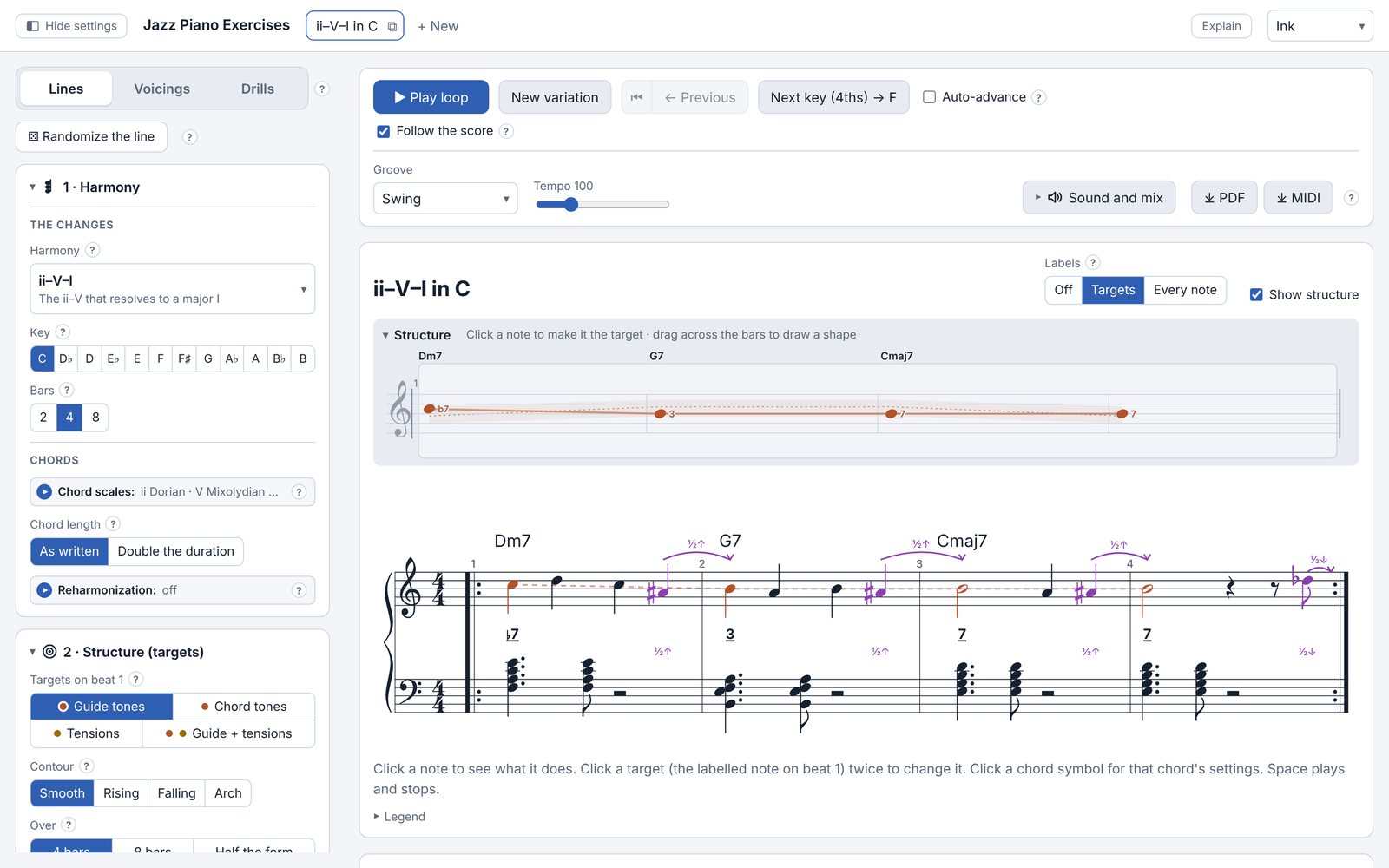
Lines: from target to target
A continuous right-hand line over the changes, with the left hand comping under it.
- Targets on guide tones, chord tones or tensions, with a contour you draw
- Whole notes up to eighths, the way the species approach builds a line
- Chromatic approaches, enclosures, bebop scales, Barry Harris, pentatonics
- Rootless A and B voicings, shells and quartal voicings in the left hand
Voicings: two hands through the changes
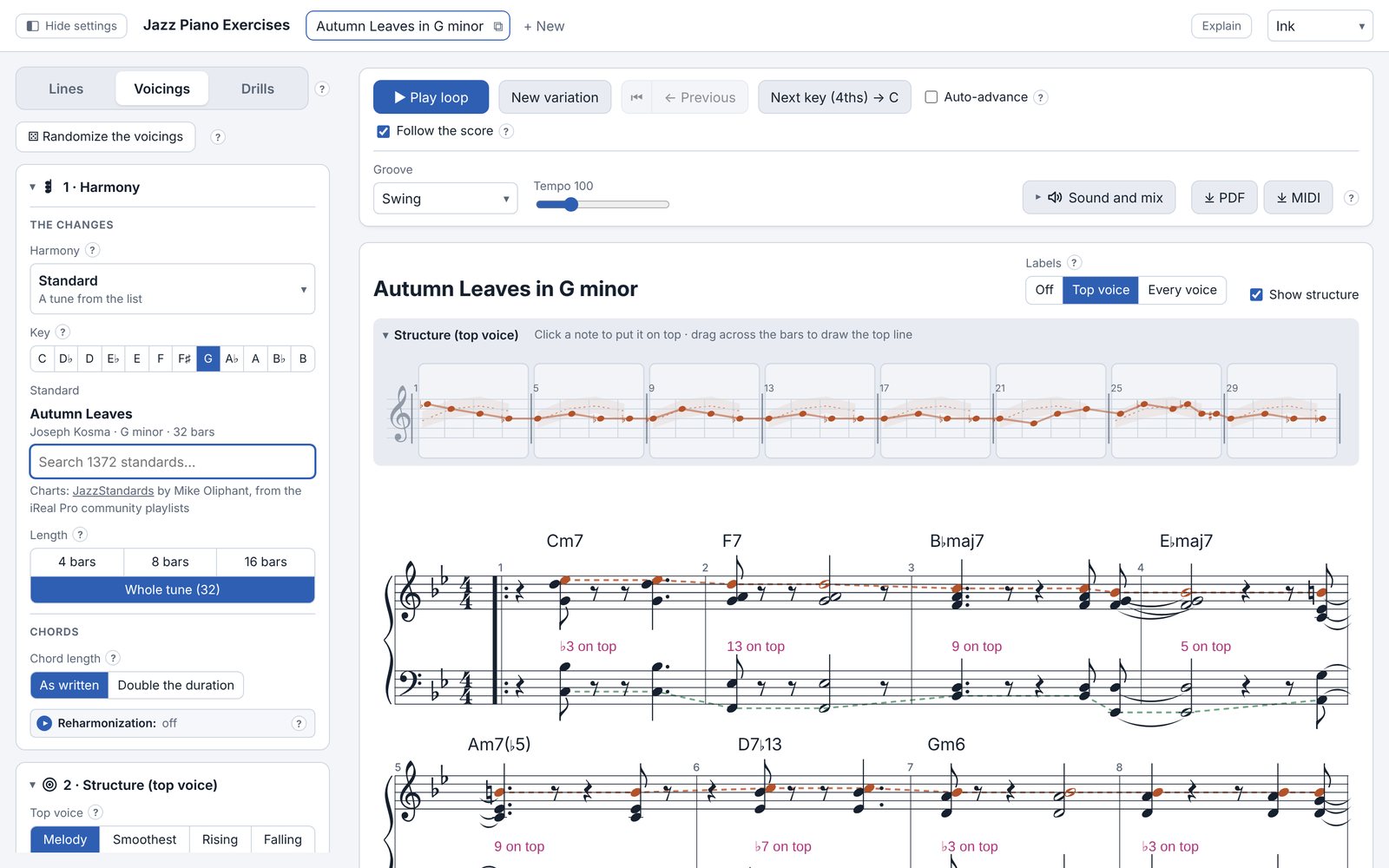
Comp through a progression or a whole standard with a singing top voice.
- Shells, drop 2, drop 3, quartal, and the sounds of famous pianists
- A top-voice melody you can shape, with every voice labelled
- Comping rhythms that breathe, with anticipations and moving inner voices
- Over about 1,300 jazz standards in the full version
Drills: technique with a purpose
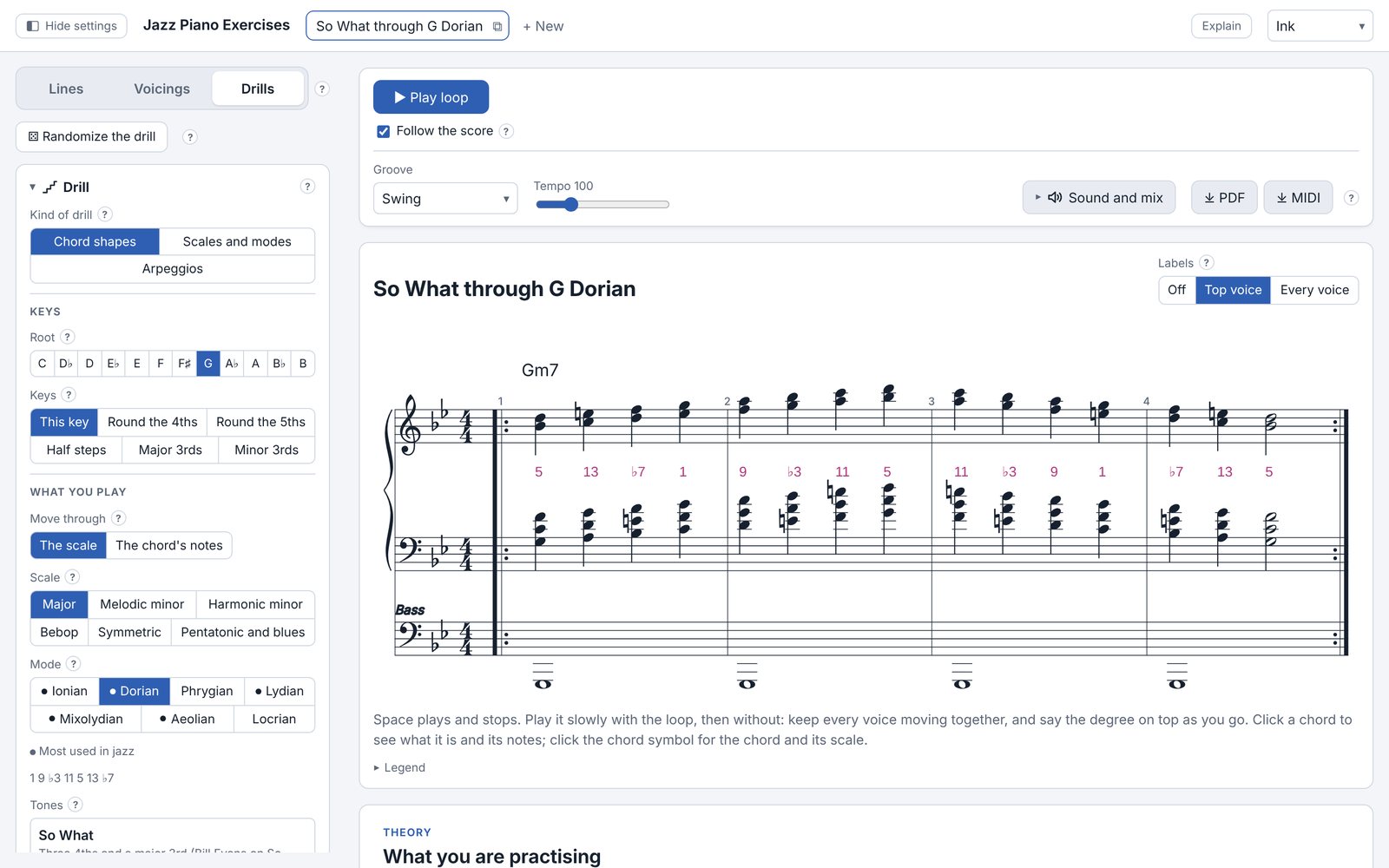
The shapes jazz pianists use, walked through a scale or a key.
- Chord shapes such as the So What voicing up and down a mode
- Scales and modes, arpeggios, in every key or round the circle
- The degree of every note shown, so you learn what you play
An explanation of everything you see
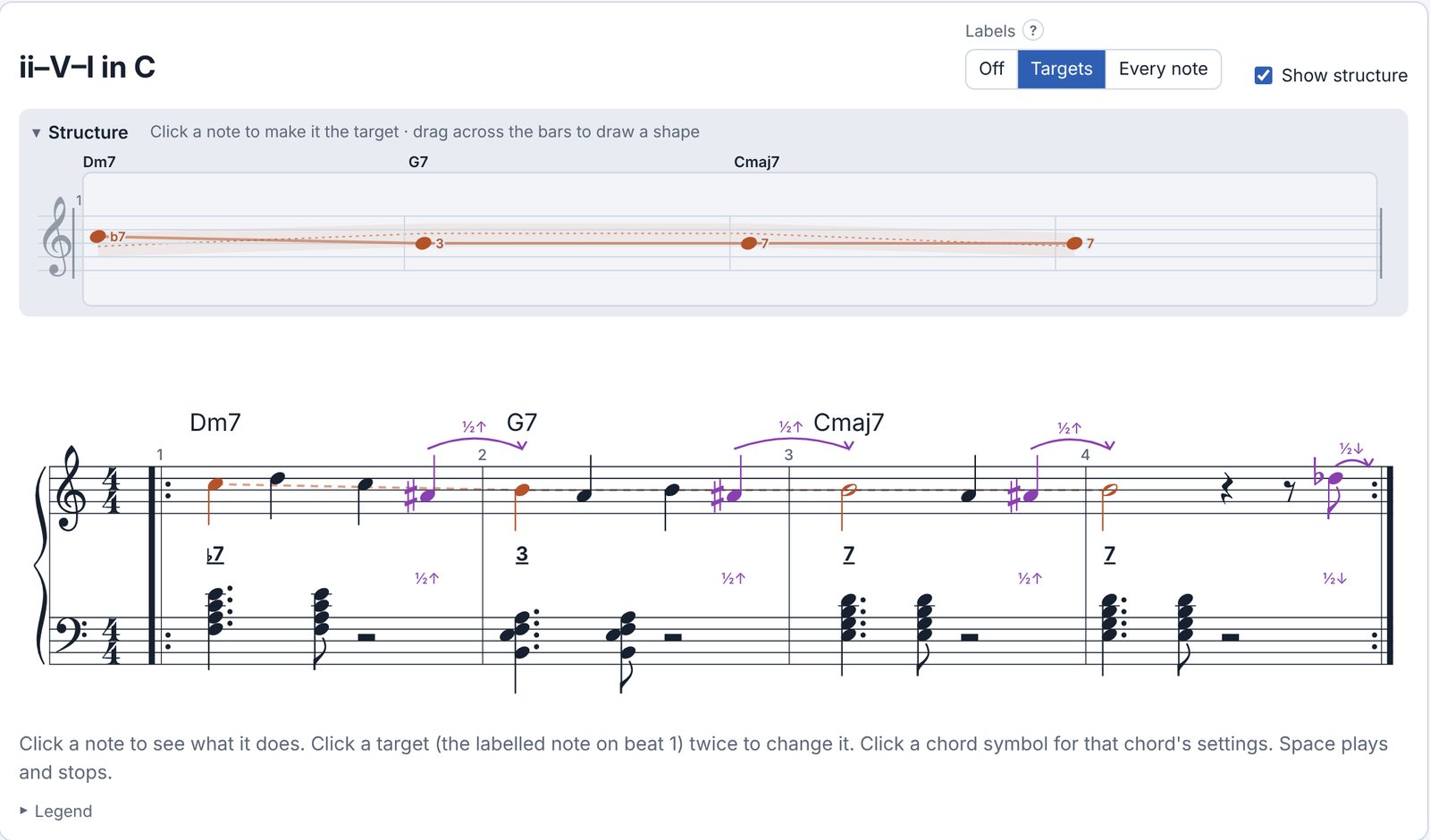
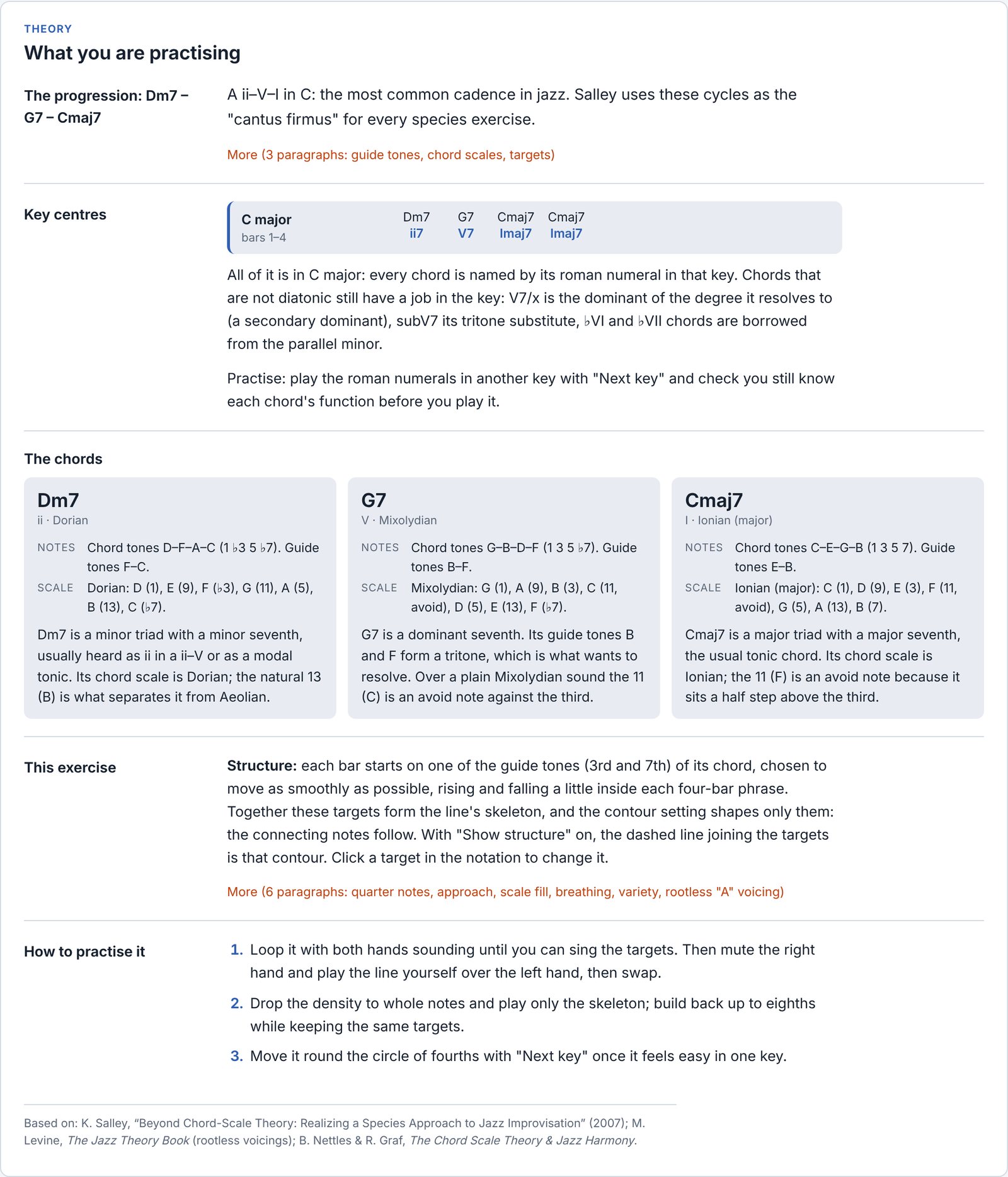
Under every exercise the theory panel explains it: the key centres, each chord and its scale, why the line goes where it goes, and how to practise it. Like a theory book that writes a new page for every exercise.
Practise with a band
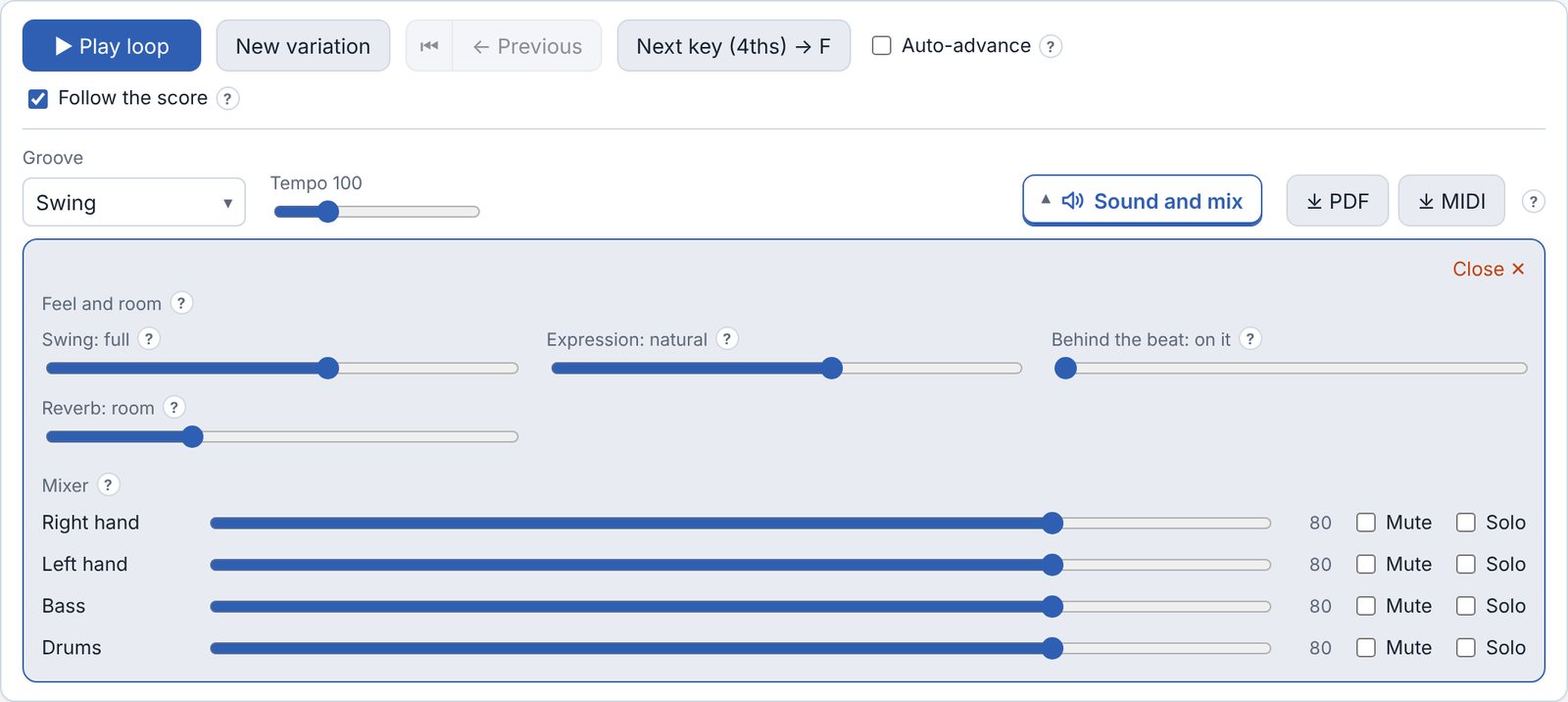
Loop the exercise with piano, bass and drums. Move it to the next key with one click, slow it down, mute the right hand and play it yourself. Take it away as a PDF to print or a MIDI file for your DAW.
Who it is for
For students, players and teachers
Conservatory students
The material of your theory and piano lessons, in every key, with endless new exercises to practise it.
Committed amateurs
A clear path from chords to lines and voicings, and an explanation whenever you wonder why.
Teachers
Make an exercise for a student in seconds, print it as a PDF, and let the theory panel do the explaining between lessons.
Free and full
Start free, unlock everything once
The free version is a real practice tool, not a demo: no time limit, every key, every explanation. The full version opens the rest of the app.
| What you get | Free | Full |
|---|---|---|
| Lines and Voicings, in all 12 keys | ✓ | ✓ |
| The theory panel and every explanation | ✓ | ✓ |
| One chord, ii–V–I major and minor, the blues | ✓ | ✓ |
| Piano, bass and drums, swing groove | ✓ | ✓ |
| Drills | – | ✓ |
| All progressions: turnarounds, rhythm changes, Coltrane changes, modal tunes… | – | ✓ |
| About 1,300 jazz standards | – | ✓ |
| Substitutions and reharmonization | – | ✓ |
| Bebop scales, Barry Harris, pentatonics, triad pairs, cells, two voices | – | ✓ |
| Pianist voicings: McCoy Tyner, Kenny Barron, Glasper, upper structures… | – | ✓ |
| Harmonize the line, Around the line comping, side-slipping | – | ✓ |
| Walking bass, pedal points, every groove | – | ✓ |
| Save as PDF and MIDI | – | ✓ |
Price
One payment. Yours to keep.
- Everything in the app, and every update
- On up to three of your own devices
- No account: unlock with the key from your receipt
FAQ
Questions
Do I need an account?
No. The app runs in your browser and keeps your settings there. After you buy, Gumroad emails you a licence key; paste it into the app once (under "Free version · Unlock all") and the full version stays unlocked in that browser.
What do I need to use it?
A recent browser on a laptop or desktop, or a tablet. Speakers or headphones. You play along on your own piano or keyboard; nothing needs to be connected.
Do I need to read music?
It helps, but every exercise also plays, the notes can be labelled with their degree (3, 7, 9…), and the theory panel describes the exercise in words.
Is this for beginners?
It is for players who know their major scales and basic seventh chords and want to start playing jazz on them. From there it goes as far as you want: bebop lines, pianist voicings, reharmonization.
Where do the standards come from?
From the iReal Pro community charts as collected by Mike Oliphant in his JazzStandards repository. The app downloads them into your browser the first time you open the list.
Can I use it on more than one device?
Yes: enter the same licence key on up to three of your own devices.
I lost my licence key.
It is in the receipt Gumroad emailed you, and in your Gumroad library. Otherwise write to hello@jazzpianoexercises.com.
Can I use it with my students?
Yes. Print exercises as PDFs for your lessons. For a class or a school licence, write to hello@jazzpianoexercises.com.